What Dementia Taught Me Before I Finished the Book
I want to tell you about my father before I tell you about what happened to him.
I want to tell you about my father before I tell you about what happened to him.
Because that is the part that matters most. And it is the part that gets lost when dementia becomes the headline.
The Man
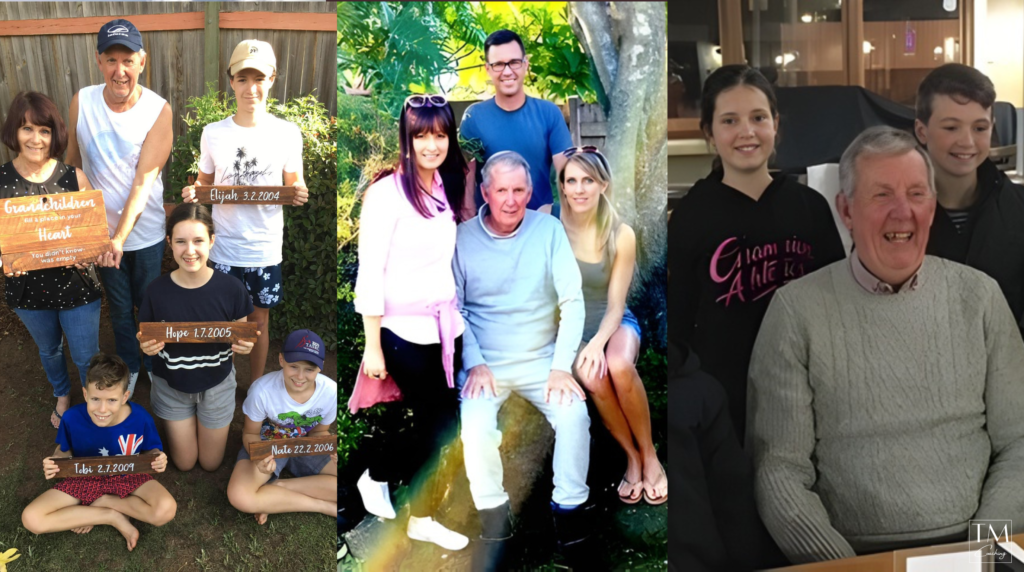
John Terence Morgan was born on 25 April 1945 in Toowoomba. He was not a man of grand gestures or loud declarations. His way was quieter than that. Family and friends were his core the thing everything else in his life was built around. He showed you who he was through the small things a well-timed word, a hug that arrived before you asked for it, a presence that made you feel like the most important person in the room without him ever saying so. That was his gift. And it never left him, even when so much else did.
He had a laugh that his niece Brooke once described as building from his toes. He would throw his whole body into it. A prolific joke teller, he would often start laughing before he had finished his joke. He thought every joke was funnier than it was, and somehow that made everyone around him laugh harder.
He worked thirty-three years on the Queensland Railway, rising from the Goods Office to Train Controller. When you visited his office, everything was in its place. Maps, T-squares, schedules. He brought work home to study because he liked to have no surprises. He was a man who believed things should be where they belonged.
After he retired, he gave twenty years to SPRED a volunteer ministry supporting people with intellectual and developmental disabilities in their spiritual and social lives. He would spend hours writing out the exact words he wanted to say for each speaking engagement, promoting SPRED and encouraging new volunteers into the organisation, then practise them until they were right. He cared that much about getting it right for the people he was serving.
He taught me to bowl a googly in the backyard. He taught me to chip kick a football so it would sit up for you to regather. He told me once, in the way that he told you most things quietly, without ceremony to be the player in your team that you would love to play beside. I have carried that onto every field and into every team I have ever been part of.
It has been all about how our Dad made other people feel. That was the theme that came back in every message, every memory shared after we lost him. Not what he did. How he made people feel.
When my sister Bec was in a car accident, I drove her back to Mum and Dad’s place. She had held it together at the scene. Held it together in the car. But the moment we walked into the kitchen and she saw Dad standing in the middle of the room, she fell into his arms and sobbed. She needed her Dad to feel safe again. He did not say much. He did not need to. That was his gift. He gave people the feeling that he understood, and that he was there, and that it was going to be alright.
He was always there. No matter what. For any of us. That was the truest thing about him.
What Lewy Body Dementia Does
I want to name the condition precisely because it matters.
Lewy Body Dementia is not the dementia most people picture. It does not arrive as simple forgetfulness and progress in a straight line. It brings hallucinations vivid, terrifying, real to the person experiencing them. It brings periods of relative clarity followed by sudden confusion. It fluctuates in ways that make it particularly cruel, because the person inside is often still present enough to know that something is wrong.
My father knew. That is the part I return to most.
He was not just losing his memory. He was losing his ability to be himself. And he was aware of it happening. The man who had always made others feel safe could feel his capacity to do that slipping away from him. The man who liked everything in its place could no longer hold things in place inside his own mind.
That frustration watching it from the outside was one of the hardest things I have ever sat with.
The Moments That Stay
There are specific moments that do not leave you.
The first piece in this series described one of them. A funeral. I found Dad alone in the bathroom, reading from a small piece of paper he had written on himself. The names of family members. A few words of context beside each one. Who they were. How they connected to him. He was studying it before walking back into the room full of people he had loved his whole life.
When he saw me, he did not hide it. He looked at me with a frustration I had not seen in him before. Not embarrassment. Something deeper than that. The frustration of a mind that knows it is losing its grip on the things it values most. The names of the people he loved were escaping him, and the piece of paper was the only way he knew how to hold on.
There were other moments. He would ask me what I did for work and genuinely not be able to retain the answer. Each time I told him it was the first time he had heard it. I watched him receive it, engage with it briefly, and lose it again. That is a particular kind of grief. Watching someone be present and absent at the same time.
His quirky sayings, the ones that had been part of our family landscape for decades, would surface from somewhere still intact. “How are your grandmother’s ducks?” he might say, from nowhere. Or he would begin singing one of his completely made-up songs. The disease was taking so much and yet these fragments of him kept appearing. That was the mercy inside the cruelty of it.
The Last Seven Months
Because of the gaps in our dementia care system and I want to say clearly that this is a system failure, not a failure of the hospital that cared for him Dad spent the last Seven months of his life at Toowoomba Base Hospital. It was not the right environment for someone with Lewy Body Dementia. The specialist support he needed did not exist in a form that could reach him. He experienced hallucinations and physical pain and total confusion about what was happening to him, in a setting designed for acute care rather than the long, slow arc of dementia.
This is a reality for many families in Australia right now. I am not writing this to assign blame. I am writing it because it is true, and because pretending otherwise does nothing for the families sitting in hospital corridors right now trying to navigate the same gap.
What our family did in response was the only thing we could do. We created our own system. Shifts. Every single day, from the start of visiting hours until Dad was tucked into bed at night, one of us was there. There was not one day across those Seven months where he spent his day without family beside him. Not one.
My mother Kay, and my sisters Belinda and Rebecca carried the heaviest part of that. They saw things a wife and daughters should not have to see. They performed acts of care and love in those hospital rooms that no role description prepares you for. They did it without complaint and without hesitation, every day, for Seven months. WE were living our father’s own lesson that love is not a feeling you describe. It is a thing you do, quietly, repeatedly, for the people who matter most.
No matter how hard the visit, no matter how agitated the condition had made him, he would always come back to us at the end with a hug and ‘I love you’. He was still giving us strength with those arms, even then.
He fought all day on the day he died. He struggled to tell us something. We could not make out what it was. But we knew. We all knew. It was the same thing he had always been telling us, in the lounge room after a shift at the Railway, at the barber on a Saturday morning, standing in the kitchen when Bec needed him most.
We were there beside him when he took his last breath. All of us. It was an honour to be there.
What His Story Means for This Series
I did not begin writing about overall health and wellbeing because of my father. I have worked in the field of exercise and wellbeing for more than twenty years. But his story is the reason I cannot write about it at a distance.
When I read Dr Tommy Wood’s work on cognitive stimulation, on the slow patterns of depletion that begin long before any diagnosis, I found myself asking questions I had never asked before. Not about the disease itself. About the years before it.
Dad was always active. He loved walking. He stayed fit throughout his life. But was the activity meaningful? Was it the kind of varied, coordinative, cognitively demanding movement that Dr Wood’s research points to as genuinely building brain capacity? Or was it the comfortable routine of a man who had found his rhythm and stayed in it? Did he architect his daily wellbeing habits deliberately, or did he simply live well by the standards of his time without the framework we now have available?
He spent thirty-three years as a shift worker. Decades of disrupted sleep, irregular hours, a body and brain that never quite settled into the deep restorative patterns that Dr Wood identifies as one of the three essential pillars of cognitive health. We did not talk about sleep deprivation as a long-term brain health risk back then. Most people still do not. But the research is clear on what sustained sleep disruption costs a brain across decades. I find myself wondering how much of that cost was paid quietly, invisibly, in the years before any symptoms appeared.
And what about the way he ate? Not whether he ate well by the standards of his time he did. But whether his nutrition choices were made with any understanding of what the brain specifically needs to sustain itself across a lifetime. That knowledge simply was not available in the way it is now. Nutrition for brain health was not a conversation anyone was having at the family dinner table in those decades. It is barely happening now.
I am not asking these questions to assign blame. Not to my father, not to anyone. I am asking them because they are the most honest thing I can offer a reader. Because most people reading this will have parents, or be parents, or be themselves living the same unexamined patterns right now. The gap between what we know today and what was understood a generation ago is significant. And that gap has a human cost.
The decline I watched in my father was not sudden. It built quietly over years. And Dr Wood’s research asks us to take seriously the daily decisions that either build cognitive capacity or quietly erode it. Not because decline is inevitable. But because the gap between the brain we build and the brain, we coast toward is determined almost entirely by how we choose to live in the years that feel ordinary.
Dad would not have used any of this language. He would have said something quieter and got it more right.
He just went on quietly working for the ones he loved the most.
I just wish we had known sooner what we know now. For him. And for all of us.
John Terence Morgan. 25 April 1945 — 8 July 2022. Loved by Kay, Troy, Belinda, Bronwyn, and Rebecca. Pop to Elijah, Hope, Nate, and Tobi.
Some of the thinking in this series was sharpened by reading The Stimulated Mind by Dr Tommy Wooda book I recommend without reservation to anyone who wants to understand the science behind what is explored here.