Your Next AI Agent Is Just a Folder. Here Is Why That Matters.
Most organisations are choosing AI platforms.
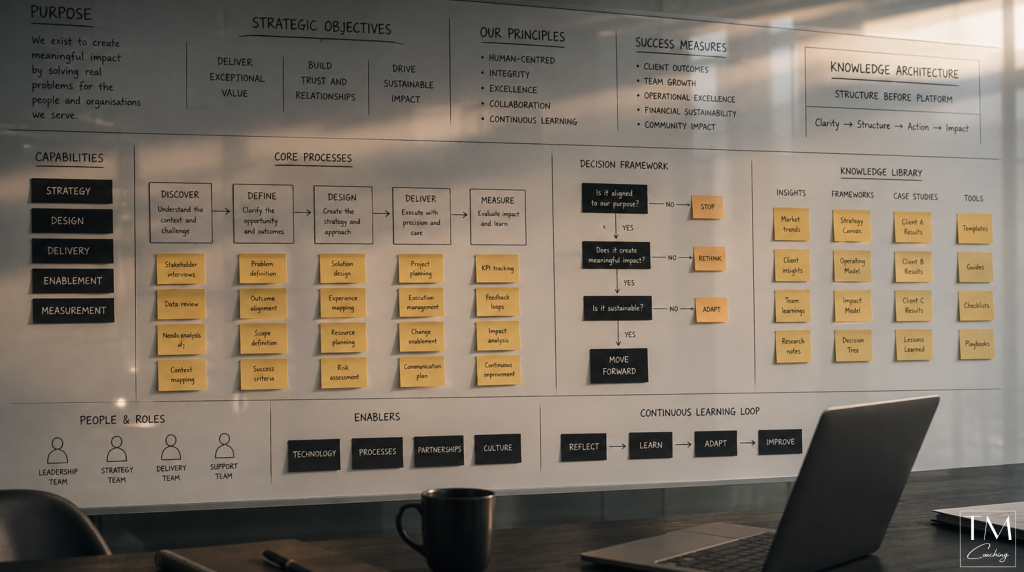
Most organisations are making the same mistake with AI. They are choosing platforms when they should be structuring knowledge.
I want to make a prediction. Within a few years, having an AI agent team will be as fundamental to an organisation as having a website. Not forward thinking. Not a competitive edge. Simply the baseline. A year ago that claim would have sounded extreme. What we now understand about AI agents has shifted that quickly.
But the prediction is not the interesting part. The interesting part is what separates the organisations that will benefit from the ones that will not. And it has almost nothing to do with the technology they choose.
What an AI agent actually is
This is where most conversations go wrong. People hear the phrase AI agent and imagine something complex: custom-coded systems, autonomous platforms, decisions being made somewhere in the background with no visibility. That is not what the most effective organisations are building.
An AI agent, in practical terms, is a folder. A structured collection of documents that gives an AI the knowledge and instructions it needs to act on an organisation’s behalf. That is the substance of it.
Think of it the way you think of a website. A website is a folder of files. It does not feel like that when you use it, but underneath it is organised content that a browser knows how to read. An AI agent works the same way: organised knowledge, well structured, that an AI platform knows how to use.
If the agent is the knowledge, then the platform is interchangeable and the knowledge is the asset.
Most organisations have this backwards. They invest heavily in choosing the tool and almost nothing in structuring what they feed it. The encouraging development is that the industry is converging on open, portable ways to structure that knowledge, built on simple files that are not tied to any single vendor. The organisations structuring their knowledge now, in a principled way, will be the ones best positioned to work with whatever platforms emerge next.
From a single agent to five layers
The natural next question is what goes into that folder. This is where early thinking tends to fall short. A well-built agent is not a pile of notes and policies. It has five distinct layers, each doing a specific job.
Identity and purpose. Who the organisation is, why it exists, and what it stands for. The foundational context behind every decision the agent makes.
Knowledge. What the agent needs to know about services, processes, expertise, and how the organisation actually operates.
Instructions. How work gets done. The workflows, rules, decision frameworks, and boundaries the agent operates within.
Evidence and outcomes. Proof of impact. The results, research, and feedback that build trust in a tender, a client conversation, or a capability assessment.
Intelligence. The patterns, trends, and benchmarks that inform better decisions over time.
Together, these five layers turn a folder of files into something that can reason and act on the organisation’s behalf. Miss a layer and the agent still performs, but generically. It sounds like everyone else’s.
One agent is not the answer
Here is what does not get said often enough. Most discussions treat an AI agent as a single thing: one assistant, one system, one deployment. That is not how it works at organisational scale.
A complex organisation needs a team of agents. One for operations. One for business development. One for governance and compliance. Agents that work independently and, increasingly, hand off to each other. A capability agent that surfaces relevant evidence and passes it to a proposal agent. An operations agent that flags a compliance gap and routes it to a governance agent for review. A client-facing agent that answers accurately from a verified knowledge base, without a subject matter expert needing to be on call.
This is the architecture emerging at the frontier of AI deployment. Not a single assistant. A coordinated team of specialists, each with its own domain, all drawing from a shared knowledge base.
Build once. Use everywhere. That is the structure worth working toward.
The foundation comes first
None of that works without the knowledge underneath it. And this is the part most organisations skip.
Before you deploy an operations agent, you need a clear map of how operational decisions actually get made. Before any agent can act with confidence on your behalf, you need to know what your organisation actually knows. That diagnostic work is unglamorous. It produces no visible product on day one. It is also the work that makes everything else possible.
Organisations that skip it deploy agents that perform generically. They use the same platforms as everyone else and get the same unremarkable outputs. The competitive advantage in an AI-enabled future does not sit in which platform you use. It sits in the quality and structure of the knowledge you bring to it.
The same discipline, at a smaller scale
I spend a great deal of time on this at the organisational level. What strikes me is how precisely it mirrors something happening at the level of the individual.
An organisation that structures its knowledge before deploying agents gets a meaningful advantage. A person who structures their thinking before they prompt gets exactly the same one.
This is the principle behind Thought Architecture: a new way of working with AI that gives individuals the system and skillset to design their thinking before they prompt. AI doesn’t replace thinking. It amplifies the structure of it. At the scale of an organisation, that structure is a knowledge base. At the scale of a person, it is the clarity you bring before the first prompt is written. Same discipline. Two scales.
The organisations and the individuals who understand that early will not simply be using AI. They will be the ones genuinely transformed by it. Every organisation needs an agent team. Every leader building one should start with the structure, not the platform.
Troy Morgan OAM Founder, Thought Architecture™ Thought Architecture — design your thinking before you prompt.